
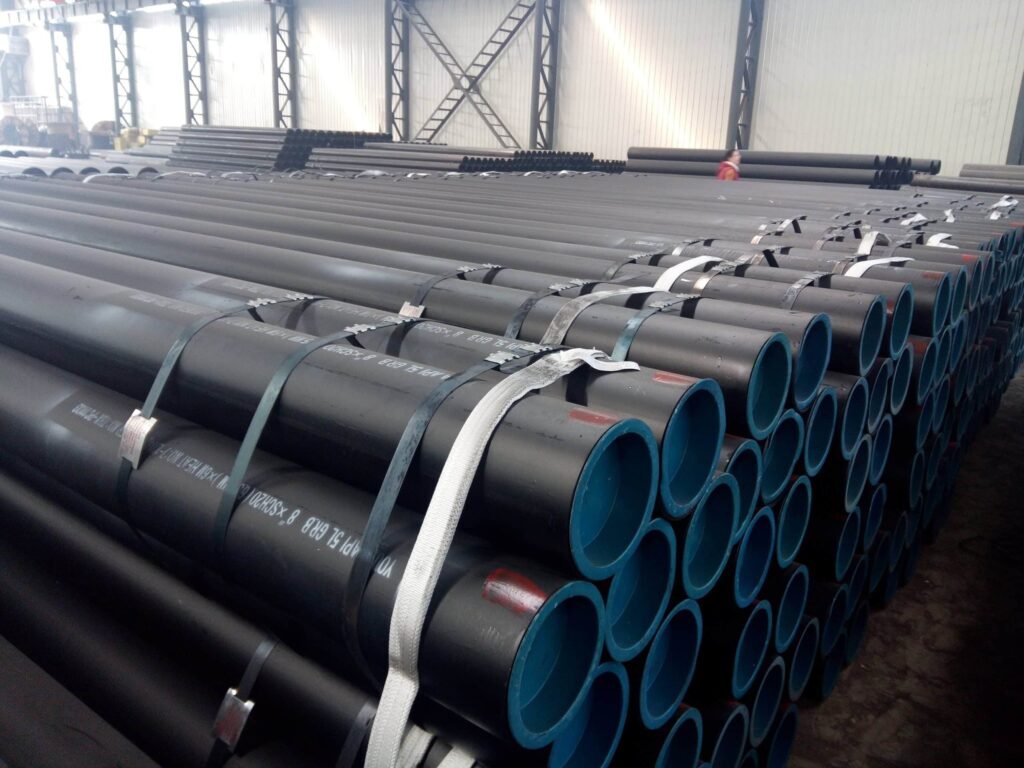
Selecting the correct carbon steel pipe specification is essential for the safety, reliability, and long-term performance of oil and gas infrastructure. Two commonly encountered specifications are API 5L and ASTM A106, both of which are widely used in industrial piping and energy-related projects.
Although these specifications can cover seamless carbon steel pipes with similar dimensions and, in some cases, comparable mechanical properties, they serve different engineering purposes. API 5L is primarily intended for steel line pipe used in pipeline transportation systems, while ASTM A106 covers seamless carbon steel pipe designed for high-temperature service.
Understanding the differences between API 5L vs ASTM A106 helps pipeline engineers, EPC contractors, procurement managers, and industrial distributors select suitable piping materials according to operating conditions, design codes, project specifications, and quality requirements.
In this guide, we compare API 5L and ASTM A106 pipe specifications, including their applications, grades, manufacturing methods, mechanical properties, inspection requirements, and key purchasing considerations.
What Is API 5L Pipe?
API 5L is a specification developed by the American Petroleum Institute (API) for the manufacture of steel line pipe used in pipeline transportation systems in the petroleum and natural gas industries.
It establishes requirements relating to pipe materials, manufacturing processes, inspection, testing, marking, and traceability. The specification covers both seamless and welded steel pipes, subject to the applicable grade, product specification level, and manufacturing route.
API 5L is commonly specified for:
- Oil and gas transmission pipelines.
- Natural gas transportation networks.
- Crude oil pipelines.
- Pipeline gathering systems.
- Gas distribution and transportation infrastructure.
- Long-distance energy transmission projects.
- Selected water and industrial pipeline applications where the project specification permits its use.
Common API 5L pipe grades
API 5L includes several grades designed for different strength requirements. Common designations include Grade B, X42, X52, X60, X65, and X70, with the available grades depending on the applicable edition and product specification level.
The “X” designation generally corresponds to the specified minimum yield strength expressed in thousands of pounds per square inch. For example, X52 corresponds to a specified minimum yield strength of 52 ksi under the applicable specification.
API 5L Grade B is a frequently specified line-pipe grade for suitable pipeline applications. Higher-strength grades may be selected when engineering calculations, operating pressure, wall thickness, and project requirements justify their use.
API 5L PSL 1 and PSL 2
API 5L distinguishes between two product specification levels:
PSL 1 — Product Specification Level 1
PSL 1 establishes the baseline requirements for pipe manufacture, chemical composition, mechanical properties, testing, and inspection.
PSL 2 — Product Specification Level 2
PSL 2 includes additional and generally more stringent requirements in specified areas, such as chemical composition, mechanical properties, testing, and quality control. Requirements depend on the grade and applicable edition.
PSL 2 may be specified for projects with more demanding material qualification and quality assurance requirements.
The selection between PSL 1 and PSL 2 should be based on the project specification, pipeline design, service conditions, and applicable regulations—not simply on price.
What Is ASTM A106 Pipe?
ASTM A106/A106M is a standard published by ASTM International for seamless carbon steel pipe intended for high-temperature service.
It covers seamless carbon steel pipe in nominal pipe sizes from NPS 1/8 through NPS 48, with dimensional provisions and other requirements defined by the applicable edition. The specification also addresses suitability for operations such as welding, bending, and flanging, subject to the specified grade and intended service.
ASTM A106 is commonly used in industrial process piping systems where elevated operating temperatures are involved.
Typical applications include:
- Oil refinery process piping.
- Petrochemical processing plants.
- Steam and condensate systems.
- High-temperature fluid transportation.
- Power generation facilities.
- Industrial boilers and associated piping systems, where specified.
- Process piping in oil and gas production facilities.
ASTM A106 is a material specification, not a complete piping system design code. Engineering teams must also consider the applicable piping code, such as ASME B31.3 for process piping or another code appropriate to the installation.
ASTM A106 pipe grades
ASTM A106 generally includes three grades:
ASTM A106 Grade A
Grade A is a lower-strength option within the A106 specification and may be suitable for applications where its mechanical properties meet the design requirements.
ASTM A106 Grade B
Grade B is widely used for seamless carbon steel process piping in refineries, petrochemical plants, and other industrial facilities. Its specified minimum tensile and yield strengths are commonly used as reference values during material selection.
ASTM A106 Grade C
Grade C provides higher specified minimum tensile and yield strengths than Grade B under the standard’s mechanical property requirements. Availability and suitability should be confirmed with the manufacturer and project specification.
The selected grade must satisfy the applicable design code, temperature, pressure, and mechanical requirements.
API 5L vs ASTM A106: Key Differences
The main difference is the intended application and the associated material qualification requirements.
| Comparison parameter | API 5L | ASTM A106 |
|---|---|---|
| Primary purpose | Steel line pipe for pipeline transportation | Seamless carbon steel pipe for high-temperature service |
| Standard organisation | American Petroleum Institute | ASTM International |
| Manufacturing methods | Seamless and specified welded manufacturing routes | Seamless only |
| Common applications | Oil and gas transmission and gathering pipelines | Refinery and industrial process piping |
| Common grades | Grade B, X42, X52, X60, X65, X70, and other permitted grades | Grade A, Grade B, Grade C |
| Product specification levels | PSL 1 and PSL 2 | No equivalent PSL 1/PSL 2 classification |
| Strength classification | Includes grades designated by specified minimum yield strength | Uses Grades A, B, and C with specified mechanical properties |
| Quality requirements | Depend on grade, PSL, manufacturing route, and applicable edition | Depend on grade, manufacturing requirements, testing, and applicable edition |
| High-temperature suitability | Must be established for the actual design and service conditions | Specifically covers seamless pipe for high-temperature service |
| Typical selection driver | Pipeline transportation requirements | Process piping and high-temperature service requirements |
Important: Neither specification is universally superior to the other. The correct choice depends on the intended service, design conditions, governing code, and project documentation.
1. Difference in Intended Application
The first and most important distinction between API 5L and ASTM A106 is the service for which each specification was developed.
API 5L: Pipeline transportation
API 5L is intended primarily for steel line pipe used to transport oil, natural gas, and other permitted fluids through pipeline systems.
Pipeline engineering considers factors such as operating pressure, specified minimum yield strength, wall thickness, external loads, fracture resistance, corrosion conditions, and the consequences of a pipeline failure.
For example, an EPC contractor installing a natural gas transmission pipeline may specify API 5L Grade B or a higher-strength grade, depending on the design calculations and project requirements.
ASTM A106: High-temperature process piping
ASTM A106 is intended for seamless carbon steel piping in high-temperature service.
It is commonly specified for refinery process lines, hot-fluid piping, steam systems, and petrochemical facilities. Material selection must account for temperature-dependent allowable stresses, pressure, wall thickness, corrosion allowance, and fabrication requirements.
For example, a refinery may require ASTM A106 Grade B seamless pipe for a process line operating at elevated temperatures, provided the material satisfies the applicable design code.
A pipe that is suitable for one application should not automatically be substituted into the other simply because the nominal dimensions are identical.
2. Difference in Manufacturing Methods
Manufacturing requirements are another major distinction.
API 5L manufacturing options
API 5L covers seamless pipe and permitted welded pipe manufacturing routes. Depending on the applicable edition and product requirements, these may include electric-welded and submerged-arc-welded products.
Common manufacturing designations encountered in line-pipe procurement include:
- S — Seamless.
- HFW — High-frequency welded.
- SAWL — Submerged-arc welded, longitudinal.
- SAWH — Submerged-arc welded, helical.
The permitted manufacturing route depends on the grade, product specification level, and applicable edition.
ASTM A106 manufacturing method
ASTM A106 covers seamless carbon steel pipe. It does not provide a general alternative for welded A106 pipe.
Seamless manufacturing forms the pipe without a longitudinal welded seam, but this does not mean the product is automatically suitable for every pressure, temperature, or corrosion environment.
Procurement consideration: If a project requires seamless pipe, specify the manufacturing route explicitly. For API 5L, confirm the permitted route and associated inspection requirements. For ASTM A106, verify compliance with the applicable seamless-pipe specification.
3. Difference in Grades and Strength Requirements
API 5L and ASTM A106 use different grade designation systems.
API 5L grades
API 5L commonly uses designations such as Grade B, X42, X52, X60, and X65. The grade identifies specified strength requirements and is used alongside the applicable product specification level and manufacturing designation.
Higher-strength line-pipe grades can help engineers optimise wall thickness and pipeline design, subject to applicable design requirements and material limitations.
ASTM A106 grades
ASTM A106 uses Grades A, B, and C.
The following commonly referenced mechanical property values illustrate the distinction between the three A106 grades:
| ASTM A106 grade | Minimum yield strength | Minimum tensile strength |
|---|---|---|
| Grade A | 30 ksi (205 MPa) | 48 ksi (330 MPa) |
| Grade B | 35 ksi (240 MPa) | 60 ksi (415 MPa) |
| Grade C | 40 ksi (275 MPa) | 70 ksi (485 MPa) |
These are commonly published nominal minimum values; always verify the applicable ASTM A106/A106M edition, units, product requirements, and purchase specification before acceptance.
Can API 5L Grade B and ASTM A106 Grade B be considered equivalent?
Not automatically.
The shared “Grade B” designation does not establish specification equivalence. API 5L Grade B and ASTM A106 Grade B have different application scopes and may differ in chemistry limits, manufacturing requirements, testing, inspection, documentation, and qualification requirements.
Even where selected mechanical properties appear comparable, a substitution requires a documented technical review and approval by the responsible engineer or purchaser.
4. Difference in Chemical Composition
Chemical composition affects strength, weldability, hardenability, and other material characteristics.
Both API 5L and ASTM A106 specify chemical composition requirements, but the applicable limits and acceptance provisions are not identical.
The permitted composition depends on the standard edition, grade, product specification level where applicable, manufacturing method, and additional service requirements.
Chemical composition considerations for API 5L
API 5L specifies chemical composition limits for the relevant grades and product specification levels. Additional restrictions may apply where requirements for sour service, offshore applications, or other special conditions are specified.
For PSL 2 pipe, requirements in areas such as carbon equivalent and mechanical properties are generally more demanding than the baseline PSL 1 provisions, subject to the specific product designation.
Chemical composition considerations for ASTM A106
ASTM A106 specifies the chemical composition requirements applicable to its carbon steel grades. These requirements must be assessed alongside the mechanical properties and intended high-temperature service.
Why chemical composition matters
During procurement and fabrication, chemical composition can influence:
- Weld procedure qualification.
- Weldability and heat-affected-zone behaviour.
- Preheating and post-weld heat-treatment requirements.
- Strength and toughness.
- Suitability for specified operating conditions.
Chemical analysis should be checked against the exact ordered specification and grade. Similar carbon steel descriptions are not sufficient evidence of compliance.
5. Difference in Testing and Inspection Requirements
Testing and inspection provide evidence that the supplied pipe meets the applicable standard and purchase order.
API 5L inspection and testing
Depending on the grade, PSL, manufacturing route, and purchase requirements, API 5L may include provisions for:
- Chemical composition verification.
- Tensile testing.
- Dimensional and visual inspection.
- Hydrostatic testing.
- Nondestructive examination.
- Impact and fracture-toughness testing where required.
- Product marking and traceability.
- Additional inspection for specified service conditions.
PSL 2 generally introduces additional requirements compared with PSL 1 in defined areas. The exact requirements must be checked against the current edition and the ordered product designation.
ASTM A106 inspection and testing
ASTM A106 includes requirements for chemical analysis, mechanical testing, dimensions, workmanship, and other acceptance criteria. Hydrostatic or permitted nondestructive electric testing provisions are addressed by the applicable edition and product requirements.
Inspection requirements should be confirmed with the manufacturer and purchaser before the purchase order is finalised.
Material Test Certificates
For both specifications, buyers should request the material documentation required by the contract. This commonly includes a material test certificate or mill test report, as applicable.
Check the documentation for:
- Standard and edition.
- Grade and manufacturing method.
- Nominal size and wall thickness.
- Heat or lot identification.
- Chemical analysis.
- Mechanical test results.
- Required hydrostatic or nondestructive testing.
- Traceability and inspection records.
- Any additional project-specific testing.
A certificate should be reviewed against the purchase order rather than accepted based on the grade name alone.
6. Difference in High-Temperature Performance
Temperature is a critical consideration when selecting carbon steel pipe.
ASTM A106 is specifically intended for seamless carbon steel pipe in high-temperature service. Its suitability for a particular process line must still be established using the applicable design code and operating conditions.
API 5L, by contrast, is primarily a line-pipe specification. An API 5L grade should not be assumed suitable for elevated-temperature process service simply because its strength values appear comparable to those of an A106 grade.
For either specification, engineers should evaluate:
- Design and operating temperatures.
- Internal design pressure.
- Temperature-dependent allowable stresses.
- Wall thickness and corrosion allowance.
- Fluid composition and corrosivity.
- Thermal cycling and mechanical loads.
- Applicable piping or pipeline design code.
- Material qualification and project restrictions.
For high-temperature refinery or petrochemical applications, the responsible engineer should verify that the material is permitted by the governing code and approved for the design conditions.
7. Difference in Dimensions, Pipe Schedules, and Wall Thickness
API 5L and ASTM A106 pipes may be supplied in overlapping nominal sizes and wall thicknesses. However, dimensional similarity does not establish technical equivalence.
Pipe dimensions and tolerances must be checked against the applicable standard, dimensional specification, and purchase order.
Understanding pipe schedules
Pipe schedules, such as Schedule 40, Schedule 80, and Schedule 160, are commonly used to identify nominal wall thickness for a specified nominal pipe size under the applicable dimensional standard.
For example, two pipes of the same nominal size may have different wall thicknesses depending on their schedule.
The selection of wall thickness depends on design pressure, temperature, material properties, corrosion allowance, manufacturing tolerances, and applicable design code requirements.
When purchasing API 5L or ASTM A106 pipe, confirm:
- Nominal pipe size (NPS) or DN.
- Outside diameter.
- Specified wall thickness.
- Schedule, where applicable.
- Length and dimensional tolerances.
- Pipe-end preparation.
- Required dimensional standard.
Never select a pipe solely by nominal size or schedule without verifying its suitability for the intended service.
8. API 5L vs ASTM A106: Which Pipe Is Better for Oil and Gas Projects?
There is no single answer for every oil and gas project. The correct specification depends on whether the pipe will be used in a pipeline transportation system or a process piping installation.
When API 5L may be the appropriate choice
API 5L is commonly considered when the project involves:
- Oil and natural gas transmission pipelines.
- Pipeline gathering and transportation networks.
- Long-distance pipeline infrastructure.
- Line-pipe procurement under an API 5L project specification.
- Requirements for PSL 1 or PSL 2 pipe.
- Specific line-pipe grades and manufacturing routes.
Example: A contractor sourcing steel pipe for a natural gas transmission pipeline may require API 5L Grade B PSL 2 or another specified grade and product designation, depending on the design and project requirements.
When ASTM A106 may be the appropriate choice
ASTM A106 is commonly considered when the project involves:
- High-temperature process piping.
- Refinery piping systems.
- Petrochemical plant piping.
- Hot-fluid and steam service.
- Seamless carbon steel piping selected under an applicable process-piping code.
Example: A refinery may specify ASTM A106 Grade B seamless carbon steel pipe for a hot process-fluid line, subject to design calculations and the governing piping code.
What about API 5L Grade B vs ASTM A106 Grade B?
Both may be encountered in oil and gas facilities, but they serve different specification purposes.
A transmission pipeline may require API 5L Grade B because the project is governed by line-pipe requirements. A refinery process line may require ASTM A106 Grade B because the piping specification calls for seamless carbon steel pipe suitable for high-temperature service.
The decision should follow the engineering documents, not an assumption that one Grade B can replace the other.
9. Can API 5L Pipe Replace ASTM A106 Pipe?
API 5L pipe should not be substituted for ASTM A106 solely because the dimensions or selected mechanical properties appear similar.
A substitution may require verification of:
- Compliance with the governing design code.
- Material properties at the design temperature.
- Chemical composition and weldability.
- Manufacturing route and quality requirements.
- Required impact, toughness, and nondestructive testing.
- Material certification and traceability.
- Purchaser, client, and engineering approval.
The same principle applies when considering ASTM A106 as a replacement for API 5L line pipe.
Recommended practice: Obtain written approval from the responsible engineering authority before accepting any alternative material specification.
10. Procurement Checklist for API 5L and ASTM A106 Pipe
For EPC contractors, industrial buyers, and procurement teams, an accurate purchase specification helps prevent material mismatches and costly project delays.
Before issuing a purchase order, verify the following:
Technical requirements
- Applicable standard and edition.
- Material grade.
- API 5L PSL designation, where applicable.
- Seamless or approved welded manufacturing route.
- Nominal pipe size and outside diameter.
- Wall thickness and schedule, where applicable.
- Required length and quantity.
- Pipe-end preparation and dimensional tolerances.
- Design pressure and temperature.
- Corrosion, sour-service, or other special requirements.
- Governing pipeline or process-piping code.
Quality and documentation
- Material test certificate or mill test report.
- Chemical analysis and mechanical test results.
- Hydrostatic or specified nondestructive testing records.
- Heat number and material traceability.
- Required third-party inspection.
- Project-specific inspection and test plan.
- Required markings and documentation.
- Client or consultant approval, where applicable.
Commercial requirements
- Manufacturer and country of origin.
- Quantity, delivery schedule, and availability.
- Required inspection and certification scope.
- Applicable coating or preservation requirements.
- Packing, handling, and shipping requirements.
- Compliance with the approved vendor list, if applicable.
A complete specification helps suppliers provide accurate quotations and enables buyers to compare technically compliant offers.
11. Sourcing API 5L and ASTM A106 Pipe for Middle East Projects
The Middle East has substantial demand for carbon steel piping across oil and gas production, refineries, petrochemical facilities, energy infrastructure, and industrial construction.
Projects in the UAE, Saudi Arabia, Qatar, Oman, Kuwait, and Bahrain may specify different pipe grades, manufacturing routes, inspection requirements, and certification documentation depending on the end user and engineering contractor.
When sourcing API 5L line pipe or ASTM A106 seamless carbon steel pipe, procurement teams should confirm:
- Compliance with the project’s approved material specification.
- Grade, size, wall thickness, and manufacturing route.
- Material certification and traceability.
- Required inspection and testing documentation.
- Delivery schedule and quantity requirements.
- Project-specific client and end-user requirements.
Gasify Middle East supports industrial procurement requirements across product categories used in the oil and gas and industrial sectors. Buyers can explore the company’s product range and submit an enquiry for project-specific requirements.
For technical and commercial enquiries, provide the required pipe specification, grade, size, wall thickness, quantity, destination, and requested delivery date to help streamline the quotation process.
Frequently Asked Questions (FAQs)
1. What is the main difference between API 5L and ASTM A106?
API 5L is primarily intended for steel line pipe used in pipeline transportation systems in the petroleum and natural gas industries. ASTM A106 covers seamless carbon steel pipe intended for high-temperature service, commonly used in process piping.
2. Is API 5L Grade B the same as ASTM A106 Grade B?
No. Both are Grade B carbon steel pipe designations, but they belong to different specifications and have different intended applications and qualification requirements. They should not be treated as interchangeable without engineering review and approval.
3. Is ASTM A106 seamless or welded?
ASTM A106 covers seamless carbon steel pipe. It does not provide a general welded-pipe alternative under the A106 specification.
4. Is API 5L available in seamless and welded pipe?
Yes. API 5L covers seamless and specified welded manufacturing routes. The permitted manufacturing method depends on the grade, product specification level, and applicable edition.
5. What is API 5L PSL 1 vs PSL 2?
PSL 1 establishes baseline product requirements, while PSL 2 includes additional or more stringent requirements in specified areas, including chemistry, mechanical properties, testing, and quality control. The exact differences depend on the applicable edition and ordered product.
6. Which is better for refinery piping: API 5L or ASTM A106?
ASTM A106 is commonly specified for suitable high-temperature refinery process piping. However, the final selection must comply with the governing design code, process conditions, and project material specification.
7. Can ASTM A106 Grade B be used for a pipeline?
Its use depends on the pipeline design code, service conditions, applicable regulations, and project specification. If the project requires API 5L, ASTM A106 should not be substituted without formal technical approval.
8. Does API 5L pipe always have higher strength than ASTM A106 pipe?
No. Strength depends on the specific grade and the applicable mechanical property requirements. Grade designations from different standards should not be compared without checking the relevant material property tables and qualification requirements.
9. What documents should buyers request when purchasing carbon steel pipe?
Buyers should request the documentation specified in the purchase order, typically including a material test certificate or mill test report, chemical and mechanical test results, required inspection records, applicable standard and grade, and traceability information.
10. How do I select the correct carbon steel pipe specification?
Start with the governing design code, intended application, design pressure and temperature, fluid characteristics, required material grade, manufacturing method, inspection requirements, and project specification. Obtain engineering approval before accepting an alternative standard.
Conclusion
API 5L and ASTM A106 are important carbon steel pipe specifications used across the oil and gas and industrial sectors, but they are designed for different primary purposes.
API 5L focuses on steel line pipe for pipeline transportation, including specified seamless and welded manufacturing routes and PSL requirements. ASTM A106 covers seamless carbon steel pipe for high-temperature service and is widely used in refinery and industrial process piping.
The most important consideration is not simply which pipe has higher strength or lower cost. It is whether the selected material meets the engineering design, governing code, operating conditions, inspection requirements, and project specification.
For procurement professionals and EPC contractors, understanding the difference between API 5L vs ASTM A106 supports better material selection, more accurate quotations, and improved project compliance.
Looking for carbon steel pipes for your next oil and gas project?
Contact Gasify Middle East with your required grade, pipe size, wall thickness, quantity, and delivery location to discuss your project requirements.
References
- American Petroleum Institute (API): API Specification 5L — Line Pipe, including the current edition and applicable updates.
- ASTM International: ASTM A106/A106M — Standard Specification for Seamless Carbon Steel Pipe for High-Temperature Service.
- Applicable ASME piping codes, project specifications, and approved material documentation.
