Selecting the right industrial valve is one of the most critical decisions in oil and gas projects. The wrong choice can lead to leakage, excessive pressure drop, premature failure, safety incidents, environmental non-compliance, and costly downtime. In the demanding conditions of upstream production, midstream pipelines, and downstream refining—especially across the Middle East’s high-pressure, often sour-service environments—valve selection must balance performance, reliability, standards compliance, and total cost of ownership.
This guide covers the key factors, common valve types, standards, materials, and a practical selection process tailored for oil & gas applications. It is written for engineers, procurement teams, and EPC contractors working on projects that require API-compliant valves from trusted regional suppliers.
Oil and gas systems handle hydrocarbons under extreme pressures (often Class 600–2500 or higher), wide temperature ranges (cryogenic LNG to high-temperature refining), corrosive media (including H₂S and CO₂ in sour service), and abrasive solids. Valves must provide reliable isolation, control, or protection while meeting strict safety and emissions requirements.
Poor selection commonly results in:
– Seat or seal degradation leading to fugitive emissions
– Erosion or corrosion failure
– Inability to achieve bubble-tight shutoff
– High maintenance costs or inability to pig pipelines
– Non-compliance with operator specifications (e.g., ADNOC, Aramco)
Proper selection reduces lifecycle costs and supports safe, efficient operations across the full value chain.
Follow a structured approach. Start with the process requirements and work through these criteria in order:
1. Service Medium / Fluid Characteristics
Crude oil, natural gas, condensate, produced water, sour gas (H₂S/CO₂), refined products, steam, or chemicals. Note viscosity, abrasiveness, toxicity, and presence of solids or hydrates.
2. Pressure and Temperature Ratings
Match ASME/API pressure classes (Class 150 to 2500+) and temperature limits. Consider design pressure, operating pressure, and potential surges or thermal expansion.
3. Required Function
– Isolation / on-off (block valves)
– Throttling / flow regulation (control)
– Backflow prevention
– Overpressure protection
Function determines the primary valve family.
4. Applicable Standards
Critical oil & gas standards include:
– API 6D – Pipeline valves (ball, gate, plug, check)
– API 600 / API 602 – Gate valves (steel and small forged)
– API 6A – Wellhead and Christmas tree valves
– API 608 / ISO 17292 – Metal ball valves
– API 609 – Butterfly valves
– API 594 – Check valves
– ASME B16.34 – Valves – Flanged, threaded, and welding end
– API 607 / API 6FA – Fire-safe testing
– NACE MR0175 / ISO 15156 – Sour service materials
– ISO 15848 – Fugitive emissions
Project-specific operator specs (Aramco, ADNOC, etc.) often add further requirements.
5. Body and Trim Materials
– Carbon steel (WCB, A105, LCC for low temperature) – general hydrocarbon service
– Stainless steel (316/316L) – corrosion resistance
– Duplex / Super Duplex (F51, F55) – chloride and sour environments
– Alloy steels (WC6, WC9, F91) – high temperature
– Nickel alloys (Inconel, Monel) – severe corrosion
Trim (seat, disc, stem) must match or exceed body corrosion resistance. Hard-facing (Stellite) is common for wear resistance.
6. Sour Service and Corrosion Considerations
For H₂S-containing fluids, specify NACE MR0175/ISO 15156 compliant materials and hardness limits to prevent sulfide stress cracking.
7. Fire-Safe and Emissions Requirements
Many hydrocarbon services require fire-safe design (API 607/6FA). Fugitive emission limits (ISO 15848) are increasingly mandatory.
8. End Connections
Flanged (RF or RTJ), butt-weld (BW), socket-weld (SW), or threaded. Match piping class and consider piggability (full-bore preferred for pipelines).
9. Actuation and Operation
Manual (lever, handwheel, gear), pneumatic, hydraulic, electric, or gas-over-oil. Emergency shutdown (ESD) valves need fast, reliable actuation and often partial-stroke testing capability.
10. Size, Flow Characteristics, and Pressure Drop
Full-bore vs reduced-bore, Cv values, and whether the valve must allow pigging or scraping. Additional practical points: maintenance access, spare parts availability, documentation (MTCs 3.1/3.2, ITP, NDE), and total cost of ownership rather than lowest purchase price.
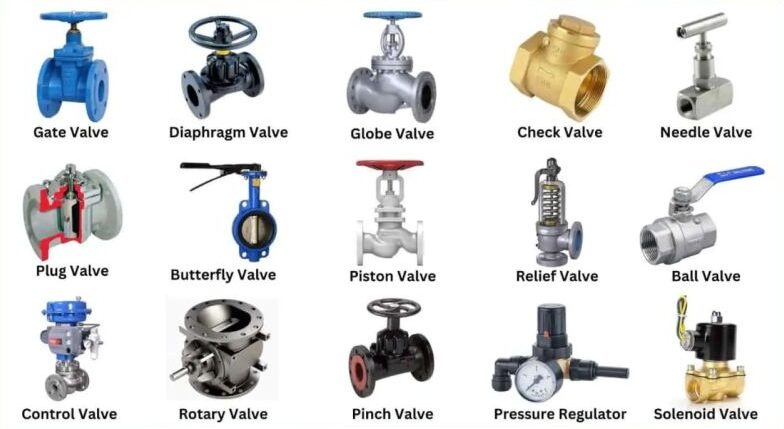
Ball Valves
Quarter-turn, excellent bubble-tight shutoff, low pressure drop (especially full-bore). Floating ball for smaller sizes/moderate pressure; trunnion-mounted for larger sizes and high pressure. Widely used in pipelines (API 6D), process isolation, and ESD service. Soft seats for clean service; metal seats for high temperature or abrasive media. Cryogenic versions available for LNG.
Gate Valves
Linear multi-turn isolation valves with very low pressure drop when fully open. Ideal for infrequent on/off service in pipelines, wellheads, and process lines (API 600/602/6D). Through-conduit or slab-gate designs support pigging. Not suitable for throttling.
Globe Valves
Excellent for throttling and precise flow control due to the seat design. Higher pressure drop than gate or ball valves. Used in process regulation, bypass lines, and where accurate control is needed. Available in T-pattern, Y-pattern, and angle designs.
Check Valves
Prevent reverse flow automatically. Swing check (API 594) for larger lines; dual-plate or wafer types for compact installations; piston or ball checks for higher performance. Critical at pump discharges and compressor stations.
Butterfly Valves
Compact, lightweight, and economical for larger diameters and lower-to-moderate pressures. Suitable for tank farms, utility lines, and some process services (API 609). High-performance and triple-offset designs improve shutoff and temperature capability. Limited for high-pressure or severe abrasive service.
Plug Valves
Quarter-turn isolation, good for dirty or slurry services and some process applications. Lubricated or non-lubricated designs. Less common than ball valves in modern pipelines but still specified in certain process and diversion duties.
Control Valves and Pressure Safety Valves
Globe-style or rotary control valves with positioners for continuous modulation. Pressure relief/safety valves (PSVs) provide overpressure protection and are mandatory on vessels and many systems per code.
– Upstream (Exploration & Production / Wellhead): API 6A gate, choke, and check valves; high-pressure ball valves. Emphasis on HPHT capability and sour service.
– Midstream (Pipelines, Storage, Terminals): API 6D trunnion ball valves and through-conduit gate valves for isolation and pigging; check valves at stations; butterfly valves for large tank farm lines.
– Downstream (Refining & Petrochemical): Mix of gate, globe, ball, butterfly, and control valves. High-temperature and corrosive service common; fire-safe and low-emission designs essential.
– LNG and Cryogenic: Specially designed ball and globe valves with extended bonnets and materials suitable for very low temperatures.
Practical Valve Selection Checklist
Before issuing an RFQ or finalizing specifications, confirm:
– Exact media composition and any contaminants
– Design and operating pressure/temperature (including extremes)
– Primary function and frequency of operation
– Required standards and operator specifications
– Material grades (body, trim, seals) and NACE compliance if applicable
– Fire-safe and fugitive emission requirements
– End connections and piping class
– Actuation type and any SIL/ESD requirements
– Size, full-bore preference, and Cv needs
– Documentation, testing (hydro, NDE, fire-safe, etc.), and inspection requirements
– Preferred manufacturers and any approved vendor list (AVL)
Share the full datasheet or process data with a knowledgeable supplier early—experienced partners will challenge incomplete or inconsistent specifications.
Sourcing Reliable Industrial Valves in the Middle East
In the GCC and broader Middle East, project success depends on timely supply of fully documented, standards-compliant valves. Regional suppliers with local stock of common carbon steel, stainless, and duplex valves (API 6D ball, API 600 gate, globe, check, etc.) can significantly reduce lead times compared with pure mill orders from Europe or Asia.
Gasify Middle East supplies a full range of industrial valves—gate, globe, check, ball (floating and trunnion), butterfly, plug, control, and pressure safety valves—in carbon steel, low-temperature, alloy, stainless, duplex, and nickel alloys. Valves are provided to API, ASME, BS, and ISO standards with complete material test certificates and traceability, supporting EPC and operator requirements across UAE, Saudi Arabia, Qatar, Oman, and beyond.
Conclusion
Effective industrial valve selection for oil and gas applications requires matching valve type, materials, and design features to the specific process conditions, safety requirements, and standards. Prioritize function first, then pressure/temperature class, media compatibility (especially sour service), and compliance. A structured checklist and early collaboration with a capable supplier minimize risk and support reliable long-term performance.
For project-specific valve recommendations, datasheet review, or supply of API-compliant industrial valves for Middle East oil and gas applications, contact a specialized regional partner with proven experience in EPC and operator specifications.